
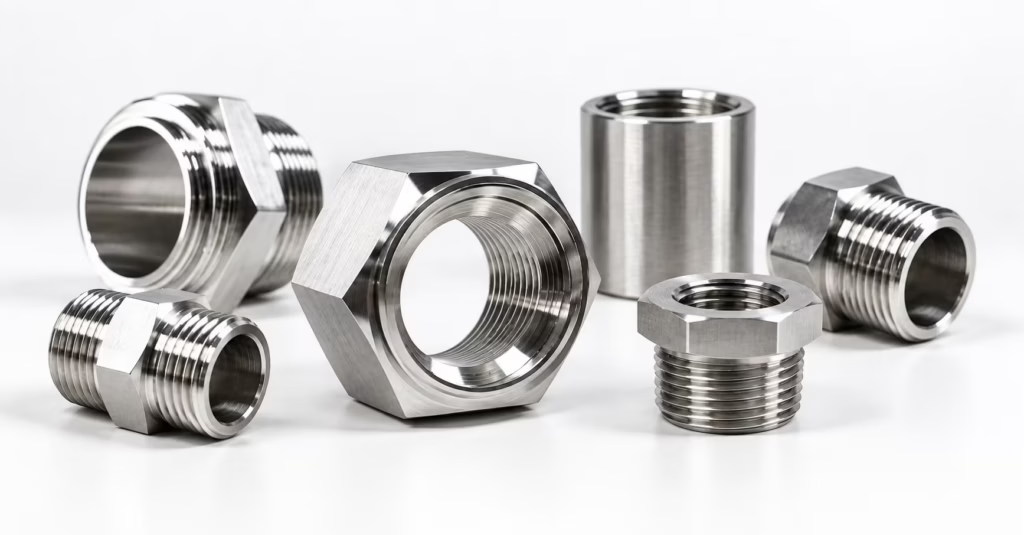
When connecting hoses, pipes, and components, it is important that the thread standards of the connections are compatible. BSPP, BSPT, NPT, and NPTF are four common designations that can easily be confused because their dimensions sometimes look similar.
The differences relate, among other things, to the shape, angle, and pitch of the thread, whether it is parallel or tapered, and how the connection is sealed. Therefore, two threads with the same nominal inch size may not be compatible.
In this guide, we'll go over the differences between BSPP, BSPT, NPT, and NPTF, and explain what you should check before connecting two components.
What does BSP stand for?
BSP stands for British Standard Pipe and is a collective term for British pipe bands. Within the BSP system, there are primarily two variants:
- BSPP – parallel thread
- BSPT – tapered thread
BSP threads have a thread angle of 55 degrees and are commonly used in Europe and other parts of the world.
For this reason, it is best to avoid specifying only BSP. Always check whether the connection is BSPP or BSPT, as they have different designs and may use different sealing methods.
What is BSPP?
BSPP stands for British Standard Parallel Pipe. The thread is parallel, which means that the diameter is the same along the entire length of the threaded section.
A BSPP thread does not normally provide the seal within the thread itself. Instead, the seal is provided by, for example:
- O-ring
- plant sealing
- packing
- metal sealing washer
- bonded seal
It is, therefore, the sealing surface and the sealing element that ensure the connection is tight. Parker, for example, specifies that a bonded seal should be used for certain BSPP connections.
BSPP is often denoted by the letter G, for example:
- G 1/4
- G 1/2
- G 1
BSPP is standardized by ISO 228-1.
What is BSPT?
BSPT stands for British Standard Tapered Pipe. It is a tapered pipe thread, which means that the diameter of the thread changes along the threaded section.
When an external and internal BSPT thread are screwed together, the threads are pressed against each other. This helps create a mechanical seal, but a suitable thread sealant is usually applied as well to fill the gaps between the threads.
BSPT is usually abbreviated as:
- R for external tapered thread
- Rc for internal tapered thread
- Rp for an internal parallel thread intended to be combined with an external R thread
BSPT is primarily regulated by ISO 7-1.
There are also several other terms for threads and couplings. In our guide to Common designations for coupling types We explain, among other things, JIC, UNF, DKO, and various BSP designations.
What is the NPT?
NPT stands for National Pipe Taper and is a tapered American pipe thread. It is often used in the process industry, hydraulics, pneumatics, and oil and gas applications.
NPT threads have a thread angle of 60 degrees. When two NPT threads are screwed together, contact occurs between the flanks of the threads. However, standard NPT is not designed to always provide a completely tight seal without a supplementary sealant.
That is why the following are often used:
- thread-sealing tape
- liquid thread sealant
- another approved sealant
The choice of a suitable sealant depends, among other things, on pressure, temperature, material, and the medium being transported.
NPT is covered by the ASME B1.20.1 standard, which specifies the dimensions and inspection requirements for American pipe threads. ASME
What is NPTF?
NPTF stands for National Pipe Taper Fuel, but is also known as a Dryseal thread.
NPTF has the same basic thread angle and taper as NPT, but the thread profile and tolerances are designed to create controlled contact between the thread crests and roots. The purpose is to minimize the spiral-shaped leakage path that might otherwise exist between the threads.
A properly installed NPTF connection can therefore provide a pressure-tight seal in certain applications without the need for a separate sealing compound. However, this requires that:
- Both components have the correct NPTF thread
- the threads are manufactured correctly
- the threads are clean and undamaged
- Installation is performed in accordance with the manufacturer's instructions
NPTF is used, for example, in fuel, hydraulic, and other fluid systems where a tight threaded connection is important.
| Gang type | Execution | Thread angle | Standard seal | Common designation |
|---|---|---|---|---|
| BSPP | Parallel | 55° | O-ring, gasket, or sealing washer | G |
| BSPT | Conical | 55° | Threaded connection and, usually, sealant | R or Rc |
| NPT | Conical | 60° | Threaded connections and sealants | NPT |
| NPTF | Conical | 60° | Controlled metallic threaded connection | NPTF |
What is the difference between BSPP and BSPT?
The most obvious difference is that the BSPP is parallel, while the BSPT is conical.
On a BSPP thread, the diameter is essentially the same along the entire length of the thread. On a BSPT thread, the diameter changes gradually. This also means that sealing is usually achieved in different ways:
- BSPP is normally sealed against a separate sealing surface.
- BSPT connections are sealed by the threads engaging with each other, usually in conjunction with a sealant.
A parallel BSPP thread should therefore not be treated as if it automatically seals within the thread itself.
What is the difference between NPT and NPTF?
Both the NPT and the NPTF have:
- conical shape
- 60-degree thread angle
- the same nominal dimensions
- normally the same number of threads per inch for the corresponding size
The difference lies mainly in the thread profile and tolerances.
NPT typically leaves a small spiral-shaped leak path and therefore requires a suitable sealant. NPTF is designed to create a pressure-tight connection without a separate sealant. In practice, however, a sealant or lubricant may still be needed depending on the material, application, and the manufacturer’s recommendations.
Despite their similarities, NPT and NPTF should not be considered completely interchangeable. Always follow the component manufacturer's recommendations.
Can BSP and NPT be linked?
BSP and NPT threads should not normally be screwed directly into one another.
Even if two fittings have the same specified inch size, there are several important differences:
- The BSP has a 55-degree thread angle.
- NPT and NPTF have a 60-degree thread angle.
- The gang's profile is different.
- The number of threads per inch may vary.
- The BSPP is parallel, while the NPT is conical.
Some dimensions may begin to thread into one another and therefore appear to fit. However, this does not mean that the connection is correct or secure. An incorrect combination can cause:
- leak
- damaged threads
- reduced pressure resistance
- inadequate procedure
- difficulties with future disassembly
Instead, use a compatible adapter between the two standards.
How to Identify the Gang Type
It is not always enough to measure the thread diameter. Since pipe threads are specified using nominal dimensions, a 1/2-inch thread, for example, does not necessarily correspond to a measured diameter of exactly 1/2 inch.
Check the following:
1. Is the thread parallel or tapered?
Measure the diameter at several points along the thread using a caliper.
- An unchanged diameter indicates a parallel thread.
- A change in diameter indicates a tapered thread.
2. Measure the diameter of the thread
Measure the outside diameter of an external thread, and then compare the result with ours Thread chart for common thread types and dimensions.
3. Check the thread pitch
It is best to use a thread gauge to determine the number of threads per inch. BSP and NPT may have different pitches even though their nominal sizes are the same.
4. Check the thread angle
BSP uses a 55-degree thread angle, while NPT and NPTF use 60 degrees. The difference can be difficult to determine without the right measuring tools.
5. Check how the connection should be sealed
The presence of a flat sealing surface, an O-ring, or a sealing washer may indicate that the connection uses a parallel thread, such as BSPP.
If you also need to compare different connections and hose sizes, you can use our Size Chart for Hoses and Fittings.
Executive summary
BSP is a collective term for BSPP and BSPT. BSPP is parallel and is normally sealed with a separate seal, while BSPT is conical and seals through thread engagement along with a suitable sealant.
NPT and NPTF are both tapered American pipe threads with a 60-degree thread angle. NPT typically requires a sealant, while NPTF has a modified thread profile designed to create a tight connection through controlled contact between the threads.
Connections that look the same are not necessarily compatible. Therefore, always check the thread standard, dimensions, pitch, sealing method, and pressure class before installing the components.
Do you need help choosing the right coupling?
Choosing the right thread and coupling is important for creating a safe and reliable connection. We’re happy to help you identify the correct thread standard and select a coupling that suits your application.
Contact us, and we'll help you find the right solution.
Contact us