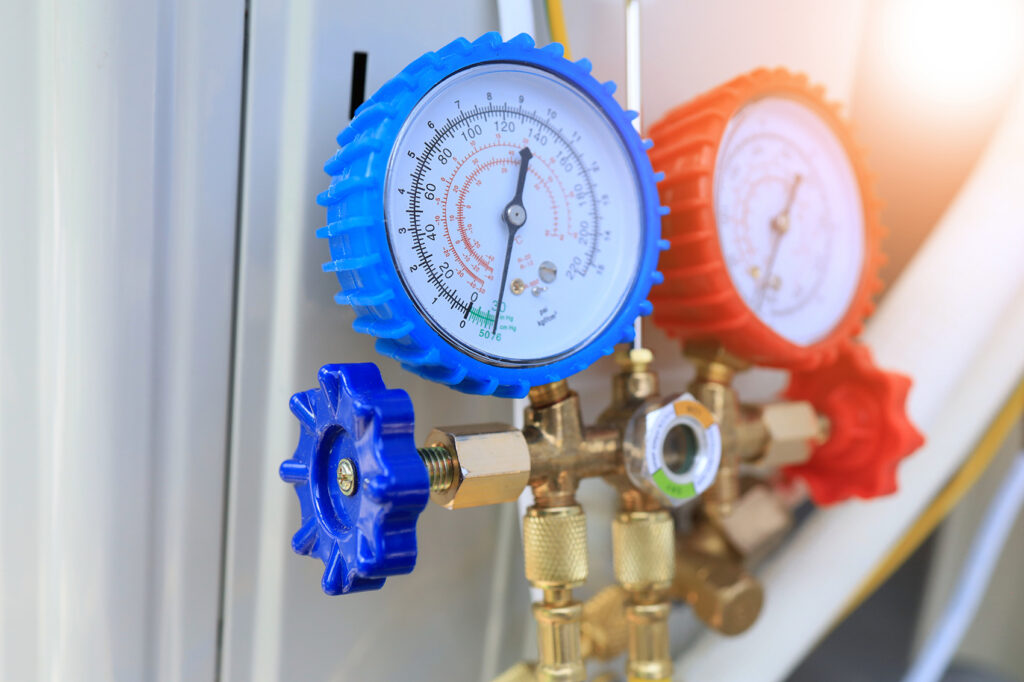
Conversion table for units of pressure: bar, Pascal, atm, and mmHg

Understanding and converting different units of pressure can sometimes feel complicated - especially as there are several different systems used in parallel in industry, engineering and science. Bar, Pascal (Pa), atmosphere (atm) and millimeters of mercury (mmHg) are some of the most common units that appear in everyday life, in laboratories and in technical specifications.
To make it easier, we have gathered here practical conversion examples where you can see how to convert between the most common units of pressure. Perfect for those who work with measuring instruments, construction, medical technology or just want to double-check conversions.
Conversion for printing
| Pressure | mm Hg | in Hg | mvp | kp/cm2 | atm | lb/sq in | bar=105 N/m2 | kPa=103 N/m2 |
|---|---|---|---|---|---|---|---|---|
| 1 mm Hg | 1 | 0,039 | 0,0136 | 0,00136 | 0,001317 | 0,01934 | 0,00133 | 0,133 |
| 1 in Hg | 25,40 | 1 | 0,0346 | 0,0346 | 0,0334 | 0,491 | 0,035 | 3,386 |
| 1 mvp | 73,53 | 2,894 | 1 | 0,1 | 0,09678 | 1,422 | 0,09785 | 9,785 |
| 1 kp/cm2=at | 735,3 | 28,939 | 10 | 1 | 0,9678 | 14,22 | 0,9807 | 98,07 |
| 1 atm | 759,3 | 29,921 | 10,33 | 1,033 | 1 | 14,70 | 1,013 | 101,3 |
| 1 lb/sq in=psi | 51,71 | 2,036 | 0,07032 | 0,07032 | 0,068 | 1 | 0,06894 | 6,894 |
| 1 bar=105 N/m2 | 751,88 | 28,94 | 10,220 | 1,020 | 0,9872 | 14,505 | 1 | 100 |
| 1 kPA=103 N/m2 | 7,52 | 0,295 | 0,1022 | 0,0102 | 0,009872 | 0,14505 | 0,01 | 1 |
| 1 MPa=106 N/m2 | 7518,80 | 2893,9 | 102,20 | 10,20 | 9,87 | 145,05 | 10 | 1000 |
Abbreviations:
- Pa = Pascal
- kPa = kilopascal
- MPa = megapascal
- bar = bar
- atm = standard atmosphere
- psi = pounds per square inch
- mmHg = millimeters of mercury
- inHg = inches of mercury
- mvp = meters of water column
- kp/cm² = kilopond per square centimeter
How much is 1 bar in Pa?
1 bar is equal to 100 000 Pascal (Pa).
Example calculation bar to Pa:
If you have a pressure of 3 bar:
3 × 100 000 = 300 000 Pa
Thus, the 3 bar = 300 000 Pa.
How much is 1 atm in Pa?
1 atm (atmosphere) is equal to 101 325 Pascal (Pa).
Example calculation atm to Pa:
If you have a pressure of 0.75 atm:
0,75 × 101 325 = 75 993,75 Pa
Thus, the 0.75 atm ≈ 75 994 Pa.
How much is 1 mmHg in Pa?
1 mmHg (millimeter of mercury) is equal to 133,322 Pascal (Pa).
Example calculation mmHg → Pa:
If you have a pressure of 650 mmHg:
650 × 133,322 = 86 659,3 Pa
Thus, the 650 mmHg ≈ 86 659 Pa.
Common Pressure Conversions
Below are some of the most common conversions between different units of pressure.
Bar to Pascal
One bar is exactly equal to 100,000 pascals.
To convert bar to pascal, multiply the value by 100,000.
Formula:
Bar × 100,000 = Pa
Example:
1 bar = 100,000 Pa
2 bar = 200,000 Pa
3 bar = 300 000 Pa
10 bar = 1,000,000 Pa
If the pressure is 6 bar, the conversion is:
6 × 100,000 = 600,000 Pa
Therefore, 6 bar is equal to 600,000 pascals.
Pascal to the bar
To convert pascals to bars, divide the value by 100,000.
Formula:
Pa ÷ 100,000 = bar
Example:
100,000 Pa = 1 bar
250,000 Pa = 2.5 bar
500,000 Pa = 5 bar
1,000,000 Pa = 10 bar
A pressure of 750,000 Pa is equivalent to:
750,000 ÷ 100,000 = 7.5 bar
Bar to kilopascal
One bar is exactly equal to 100 kilopascals.
Formula:
Bar × 100 = kPa
Example:
1 bar = 100 kPa
2.5 bar = 250 kPa
5 bar = 500 kPa
10 bar = 1,000 kPa
To convert in the other direction, divide the number of kilopascals by 100.
Bar to megapascal
One bar is equal to 0.1 megapascal.
Formula:
Bar ÷ 10 = MPa
Example:
1 bar = 0.1 MPa
5 bar = 0.5 MPa
10 bar = 1 MPa
100 bar = 10 MPa
Megapascals are often used for higher pressures, such as in hydraulics, high-pressure systems, and engineering material calculations.
Megapascal to bar
To convert megapascals to bars, multiply the value by 10.
Formula:
MPa × 10 = bar
Example:
0.5 MPa = 5 bar
1 MPa = 10 bar
5 MPa = 50 bar
20 MPa = 200 bar
Bar to psi
Psi is a common unit of pressure in American and British technical specifications. The abbreviation stands for pounds per square inch.
One bar is equivalent to approximately 14.5038 psi.
Formula:
Bar × 14.5038 = psi
Example:
1 bar ≈ 14.50 psi
2 bar ≈ 29.01 psi
5 bar ≈ 72.52 psi
10 bar ≈ 145.04 psi
If a hose has a maximum working pressure of 8 bar, this corresponds to:
8 × 14.5038 ≈ 116.03 psi
Psi to Bar
To convert psi to bar, multiply the value by approximately 0.06895.
Formula:
Psi × 0.06895 = bar
Example:
10 psi ≈ 0.69 bar
50 psi ≈ 3.45 bar
100 psi ≈ 6.89 bar
150 psi ≈ 10.34 bar
A pressure of 200 psi is equivalent to:
200 × 0.06895 ≈ 13.79 bar
Atmosphere to Pascal
One standard atmosphere is exactly equal to 101,325 pascals.
Formula:
Atm × 101,325 = Pa
Example:
1 atm = 101,325 Pa
0.5 atm = 50,662.5 Pa
2 atm = 202,650 Pa
If the pressure is 0.75 atm, the conversion is:
0,75 × 101 325 = 75 993,75 Pa
Therefore, 0.75 atm is approximately equal to 75,994 pascals.
Bar Atmosphere
One standard atmosphere is equivalent to approximately 1.01325 bar.
Formula:
Atm × 1.01325 = bar
Example:
1 atm ≈ 1.013 bar
2 atm ≈ 2.027 bar
5 atm ≈ 5.066 bar
Atmosphere is used in fields such as physics, chemistry, and laboratory work.
Do you need help choosing the right component based on the pressure?
When selecting hoses, pumps, pipes, and fittings, several factors must be taken into account. In addition to the system’s operating pressure, temperature, media, flow rate, pressure surges, dimensions, and material requirements can all influence which solution is most suitable.
We're happy to help you interpret technical specifications, convert pressure units, and select components tailored to your application.
Get help choosing the right component