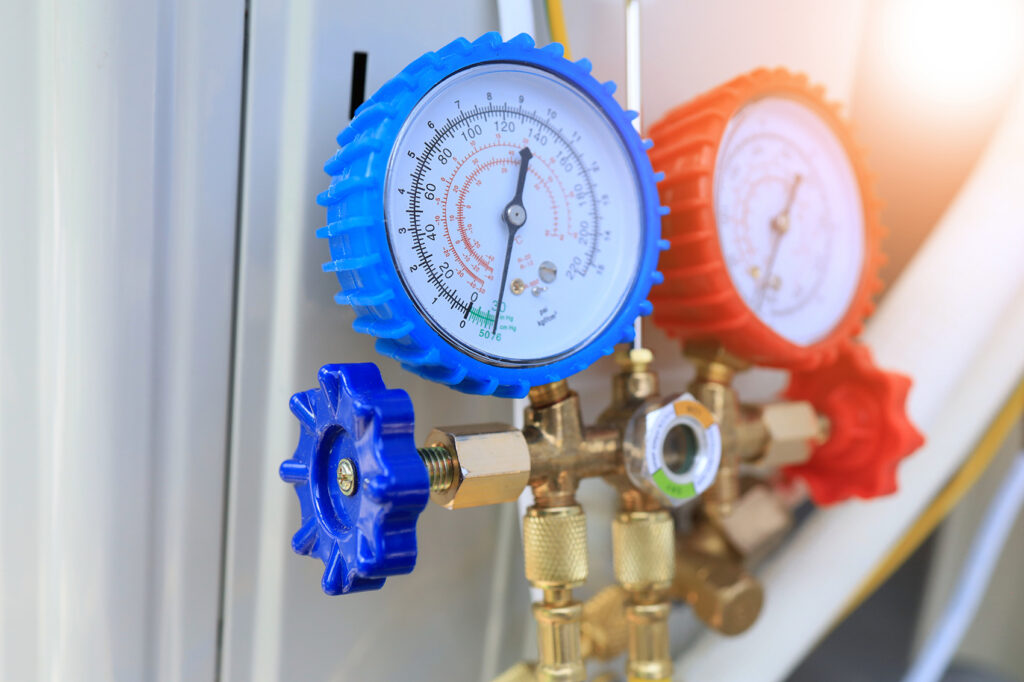
Vacuum plays a central role in many industries, from manufacturing to research. In this guide, we explain the methods, devices, and scales used to measure vacuum, to help you better understand vacuum.
Conversion Table for Vacuum Units
| From | To | Conversion Calculation |
|---|---|---|
| mbar | Pascal (Pa) | Pa = mbar × 100 |
| Pascal (Pa) | mbar | mbar = Pa/100 |
| Dry / mmHg | mbar | mbar = Torr · 1.33322 |
| mbar | Dry / mmHg | Dry = mbar/1.33322 |
| Atmosphere (atm) | mbar | mbar = atm × 1013.25 |
Abbreviations and Terms:
- mbar = Millibar (common industrial unit)
- Pa = Pascal (SI unit of pressure; 1 Pa = 1 N/m²)
- Dry / mmHg = Millimeters of mercury
- Absolute pressure = Pressure measured from absolute zero (perfect vacuum = 0 mbar absolute)
- Negative Pressure = The difference between the current pressure and the ambient atmospheric pressure
How much is 1 standard atmosphere in mbar?
1 standard atmosphere (atm) is equal to 1,013.25 mbar (or approximately 1013 hPa at sea level).
Sample calculation from mbar to pascal:
If your blood pressure is 500 mbar:
500 · 100 = 50,000 Pa (which is equivalent to 50 kPa).
Therefore, 500 mbar = 50,000 Pa.
Common conversions and concepts in vacuum physics
1. Absolute Pressure vs. Relative Vacuum (Negative Pressure)
When working with vacuum, it is crucial to distinguish between measuring absolute pressure and pressure relative to atmospheric pressure.
- Absolute pressure: Based on absolute zero (0 mbar). A perfect vacuum is 0 mbar absolute.
- Relative pressure (negative pressure): Shows how much lower the pressure is than the surrounding atmospheric pressure. This is often expressed as a percentage (%) of vacuum or in negative pressure units (e.g., -750 mmHg).
2. Millibar (mbar) and Pascal (Pa)
These are the most common devices used in modern industrial pneumatics and vacuum technology.
- Formula for converting from mbar to Pa: mbar × 100 = Pa
- Example:
- 1,000 mbar = 100,000 Pa (normal atmospheric pressure)
- 10 mbar = 1,000 Pa (low vacuum)
- 1 mbar = 100 Pa
3. Dry and mmHg
Torr (named after Evangelista Torricelli) is, in practice, the same as a millimeter of mercury ($\text{mmHg}$). This unit is often used in science, research, and older vacuum systems.
- Formula: Dry · 1.333 = mbar
- Example: 760 Torr = 1013.25 mbar (1 atm)
Do you need help choosing the right component for vacuum applications?
When selecting vacuum pumps, hoses, valves, pipes, and fittings, several factors must be taken into account. In addition to the system’s vacuum level (rough, fine, or high vacuum), the medium, flow rate, leak rate, material requirements, and mechanical stress can influence which solution is best suited for your process.
We’re happy to help you interpret technical specifications, convert units, and select components that are precisely tailored to your vacuum application.
Get help choosing the right component