Knowledge Article
Composite hose in assembly: A safe and flexible solution in demanding environments

In process industries such as chemicals, energy and refining, the demands on hose solutions are high. They must withstand aggressive fluids, be easy to handle and work safely in environments where a misstep can be costly - both in time and money. Here, composite hoses have established themselves as a smart and sustainable choice. But it's not just the hose itself that determines the outcome. In fact, an incorrect installation can ruin your entire investment. That's why the right installation is crucial for safety, longevity and trouble-free operation.
In this blog post, we explain why correct assembly is so important, what risks can be avoided and how we at Colly Flowtech, together with our supplier Matec Group, deliver documented and safe hose solutions for demanding industrial environments.
What is a composite hose and when is it needed?
Composite hoses are made up of several layers - such as plastic film, reinforced textile and metal spirals - making them both lighter and more flexible than traditional rubberi or PTFE. At the same time, they have impressive chemical resistance and mechanical durability, even when handling aggressive liquids such as acids, solvents, hydrocarbons and fuels.
Their characteristics make them particularly suitable for:
- Unloading of chemicals from tankers
- Transfer of liquids between ship and terminal
- Handling of corrosive or flammable liquids
- Process environments with explosion risk
But precisely because the construction is more advanced, composite hoses also require more precision in assembly.
Correct hose assembly - the basis for safe and long-term operation
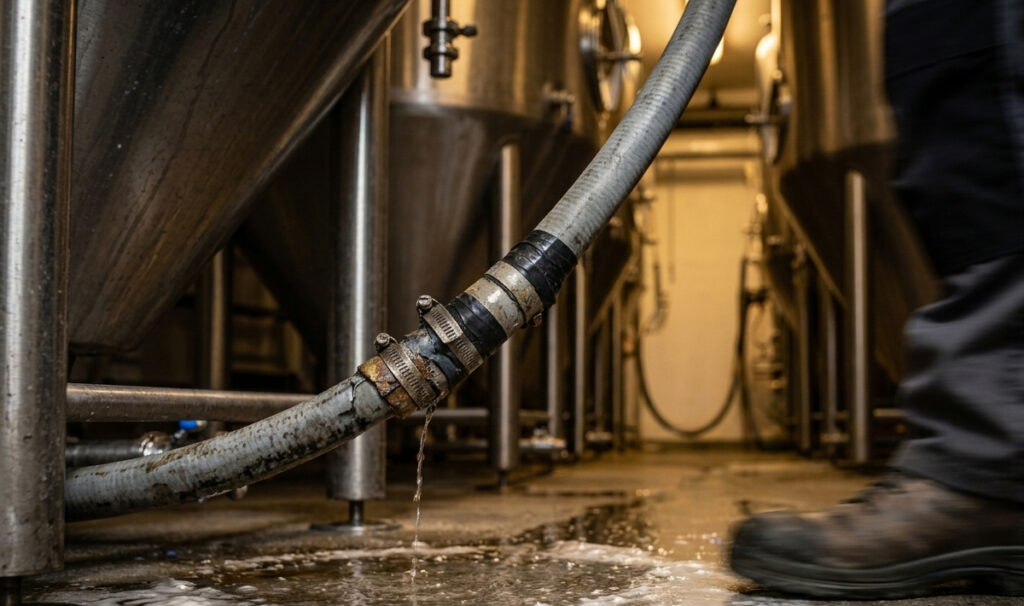
A composite hose can be as tough as they come - but if fitted incorrectly, it can still lead to leaks, downtime or, in the worst case, injury. That's why it's not enough to have the right hose, you also need the right coupling, the right crimping, the right grounding and the right documentation.
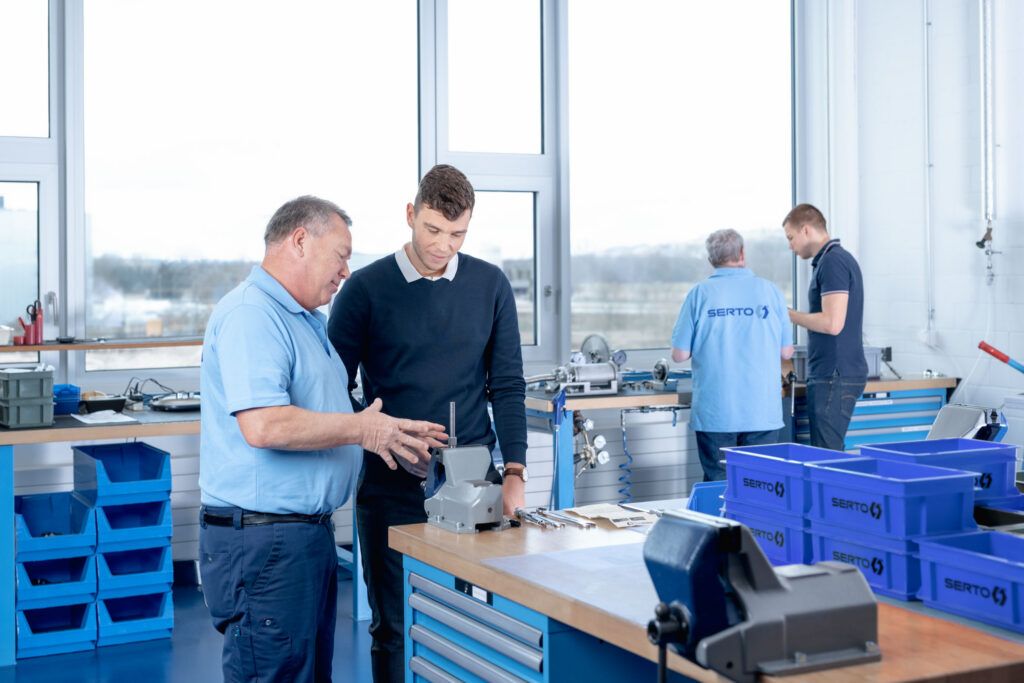
At Colly Flowtech, all assembly takes place in our own workshops, with the right tools, working methods and quality assurance. We adapt the couplings to the design and application of the hose, use precise pressure when pressing and ensure that the hose can dissipate static electricity in ATEX-classified environments. Each hose is labeled and documented, which simplifies both service and traceability over time.
The benefits of properly fitted composite hose
The strength of composite hose lies in the combination of low weight, high performance and good chemical resistance. Properly assembled and handled, it can have a long lifetime - but as with all technical equipment, durability is affected by usage patterns, loading and maintenance.
That is why we at Colly Flowtech work preventively by:
- Inventory and status assessment
- Labelling and documentation
- Recommendations for service intervals
- Phasing out of older hose types
A sustainable system for a demanding reality
Composite hoses are used almost exclusively in processes where flawless performance is a requirement - unloading corrosive liquids, transferring flammable liquids, or ship-to-shore connections. In these applications, it's the whole picture that counts: the right hose, the right coupling, the right installation and the right maintenance.
Together with Matec Group, we at Colly Flowtech offer a specialized range with a clear focus on safety, performance and traceability. With our technical expertise in assembly, pressurization and labeling, we can take full responsibility - from analysis to delivery.
Want to know more about how our composite hose solutions can contribute to a safer and more accessible process? Please get in touch - I'm happy to help you further!
This text was written by Tobias Sander (tobias.sander@colly.se), Sales Manager Hoses at Colly Flowtech.
Explore our range of hosesFrequently asked questions about composite hose and installation
What is the difference between a composite hose and a rubber hose?
Composite hoses consist of several layers of polymer films, textile reinforcement and metal spirals, giving them a unique combination of low weight and high chemical resistance. They are more flexible and lighter than rubber hoses, but also require more advanced assembly.
When is composite hose the best choice?
When handling aggressive liquids such as acids, solvents, hydrocarbons or fuels - especially in ATEX-classified environments or during mobile handling such as unloading from tankers or ships.
Can I install the composite hose myself?
We strongly advise against it. Composite hoses require specific couplings, correct torque and proper grounding. Incorrect assembly can cause internal damage that is not visible until operation, which can lead to leakage, breakdown or in the worst case an accident.
How long does a composite hose last?
Lifespan varies depending on the application, but with proper installation and maintenance we see examples of hoses that last five more years. Others, installed incorrectly or used in the wrong environment, may need replacing after just one year.
How often should I check my composite hose?
We recommend regular visual checks and a more thorough inspection at least once a year. Check the connections, condition of the hose, labeling and grounding. If in doubt - replace or consult us.
Do you have any questions?