Knowledge Article
How a diaphragm pump works: A guide to more efficient industrial processes

Diaphragm pumps are one of the most versatile types of pumps for industrial processes on the market. Thanks to their robust construction and ability to handle both sensitive, viscous and aggressive media, they companies use them from food and pharmaceutical production to the chemical industry.
But what makes the diaphragm pump so popular in demanding environments - and how can it contribute to more stable operation and lower costs in your production?
Diaphragm pumps - how the technology works in practice
In diaphragm pump is a positive displacement pump - a pump technology that many industries use to handle everything from water to chemicals. The process is simple but effective: first the pump creates a vacuum that sucks the liquid into the pump chamber, then the diaphragm pushes the liquid forward and out through the outlet, and then the pump repeats the cycle.
A key strength is that the pump can run even against a closed valve without damage. The air pressure on the back of the diaphragm always corresponds to the fluid pressure - a feature that distinguishes diaphragm pumps from many other technologies.
The working principle of diaphragm pumps step by step
The approach can be divided into three steps:
- Sugfas - the diaphragm retracts, creating a negative pressure that sucks the liquid into the pump chamber.
- Pressure phase - the second membrane pushes the liquid forward and out through the outlet.
- Bicycle - the process is continuously repeated, creating a smooth flow.
This makes diaphragm pumps particularly reliable even in processes where pressure and flow vary.

Common uses of diaphragm pumps in industry
Many industries use diaphragm pumps because they are both reliable and flexible. Below we have mentioned some typical examples:
- Surface treatment: a safe solution for aggressive chemicals.
- Food and drink: gentle handling preserves texture and flavor.
- Pharmaceuticals: meets hygiene, documentation and traceability requirements.
- Process industry: can handle viscous, abrasive and aggressive media.
It is precisely this breadth that makes diaphragm pumps so valuable. Whether protecting sensitive products, meeting stringent hygiene requirements or handling challenging media, they offer a solution that combines flexibility, safety and reliable operation.
Benefits that boost production
For many businesses, it is not the individual features, but the combination, that makes diaphragm pumps the first choice. They are self-priming, can withstand dry operation without damage and have a seal-less design that makes them completely leak-free. At the same time, they are gentle on sensitive products, require minimal maintenance and come in a range of sizes that can be easily integrated into existing systems. The result is a pump technology that not only increases safety, but also contributes to more stable operation, lower total costs and minimal maintenance thanks to few moving parts. Read more about how the right choice of materials can optimize lifetime and performance in the article Maximizing efficiency: A deep dive into the characteristics of diaphragm pumps.
The pump type provides a pulsating flow, can be dry-run and has a wide application range, also in ATEX environment. Limitations of the pump type can be high flow rates and energy consumption in continuous 24/7 operations.
An investment in both safety and efficiency
A diaphragm pump is more than a standard solution - it combines gentle handling, high flexibility and long service life. That's why many companies choose it as one of the most widely used pump types in processes where quality, safety and operating economy are crucial.
At Colly Flowtech, we offer both knowledge and experience to help you find the right diaphragm pump for your process. Whether it's to increase safety, reduce maintenance costs or improve product quality, we are here as a long-term partner.
If you have any questions or would like to discuss a future project, please contact me (mikael.hjort@colly.se), +46 (0)36 18 11 63 and I will be happy to help you further.
This text was written by Mikael Hjort (mikael.hjort@colly.se), Technical Sales Support Pump at Colly Flowtech.
Frequently asked questions about diaphragm pumps
What is a diaphragm pump?
A diaphragm pump is a positive displacement pump that uses two flexible diaphragms to transport fluid. It creates a pulsating flow and is used in many industries due to its versatility and ability to handle both sensitive, viscous and aggressive media.
What are the benefits of a diaphragm pump?
Diaphragm pumps are self-priming, can handle abrasive and viscous fluids, can be run dry without damage and have very good chemical resistance. A unique advantage of air-operated diaphragm pumps is that they can be stopped under pressure without damage.
What are the typical applications for diaphragm pumps?
Diaphragm pumps are used in the chemical, food, pharmaceutical, mining, wastewater treatment, oil and gas industries, among others. They are particularly common for transferring, circulating and dosing liquids in demanding processes.
Can a diaphragm pump handle highly viscous liquids?
Yes, diaphragm pumps can handle highly viscous fluids. Special models have larger pump casings, heavier valve balls and lower stroke rates to pump thicker media safely and efficiently.
How do I choose the right diaphragm pump for my application?
To choose the right diaphragm pump, you should consider the flow, pressure, fluid properties, temperature range and whether the fluid contains particles or abrasive substances. The right choice ensures both operational reliability and a long service life.
Do you have any questions?

Mikael Hjorth
Technical sales support - Diaphragm pumps
Phone:
+46 36 18 11 63
Email:
mikael.hjorth@colly.se
explore our range of diaphragm pumps

The Versamatic E Series is an air-driven diaphragm pump designed for industrial applications. The series is available in a wide range of materials and sizes.

The P35 series is a plastic, compressed-air-driven diaphragm pump from Dominator Pump. The series is available in the P35P/D and P36P/D models.
3
variaties

The P10 series is an ATEX-certified, aluminum-bodied, compressed-air-driven diaphragm pump from Dominator Pump. The series includes the P10A, P11A, and T10A models.
2
variaties

The P30 series is an ATEX-certified, aluminum-bodied, compressed-air-driven diaphragm pump from Dominator Pump. The series is available in the P30A and P31A models.
3
variaties
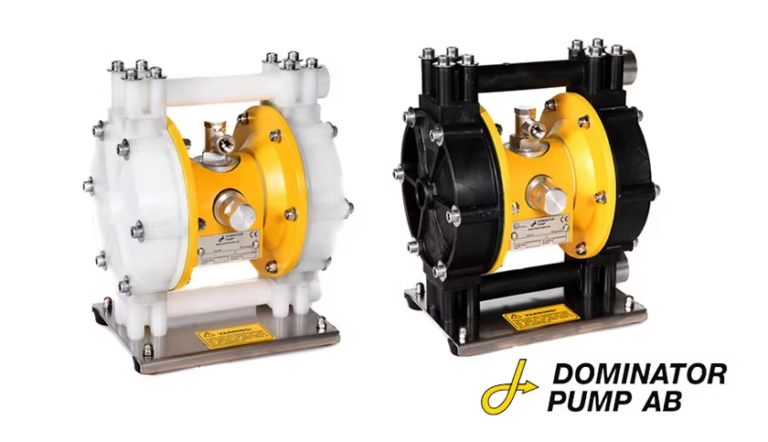
The P15 series is a plastic, compressed-air-driven diaphragm pump from Dominator Pump. The series includes the P15P/D, P16P/D, and T15P/D models.
3
variaties

The P18 series is an ATEX-certified, compressed-air-driven diaphragm pump made of acid-resistant steel with a hygienic design from Dominator Pump. The series includes the P10S, P11S, P18S, and P19S models.
2
variaties
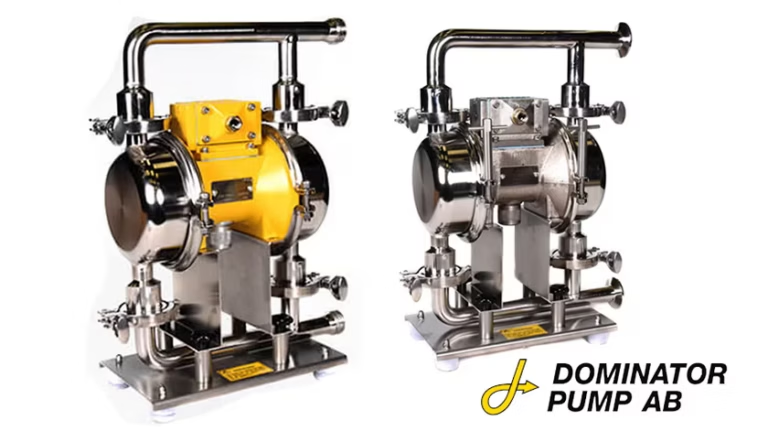
The P38 series is an ATEX-certified, compressed-air-driven diaphragm pump made of acid-resistant steel with a hygienic design from Dominator Pump. The series is available in the following models: P30S, P31S, P38S, and P39S.
3
variaties