Knowledge Article
PTFE hoses and total cost of ownership: why “more expensive” is often cheaper

PTFE hose total cost of ownership is a decisive factor in many industrial applications, yet hoses are often compared on purchase price alone. Comparing hoses on purchase price is easy. Significantly more difficult is assessing their total cost of ownership (TCO), i.e. what the hose actually costs over time when installation, operation, maintenance, risk and quality are taken into account.
In many industrial applications, the hose is a relatively small part of the total investment. At the same time, it can have a disproportionate impact on operation, process stability and service life. This is especially true in environments with: aggressive chemicals, high temperatures, high purity and contamination control requirements, high pressure or pulsating flows, and critical process windows where variation is expensive.
In those contexts, a PTFE hose is rarely the cheapest option in purchase. But it is often the most economical choice over time.
Why purchase price rarely tells the whole truth
When analyzing PTFE hose total cost of ownership, it becomes clear that price per meter rarely reflects the true cost of a system. Instead, what drives the cost are the following factors:
- Unplanned stoppages and production losses
- Extra exchanges (material, labor, downtime, restart)
- Variation in the process (quality deviations, rejection, rework)
- Risk (leakage, contamination, safety, environment)
- Documentation requirements (traceability, material certificates, validation)
It is rarely the cheapest component that has the greatest economic impact. Instead, it is the interruptions, variations and uncertainties that drive costs over time.
PTFE in practice: properties that affect the economy
PTFE (polytetrafluoroethylene) is often used when the process environment is demanding, not because it is “nice”, but because the material reduces hidden costs.
1. Broad chemical resistance
PTFE has very good resistance to a wide range of chemicals. The result is:
- less risk of degradation and cracking
- longer lifetime in aggressive media
- fewer emergency replacements and less operational uncertainty
2. temperature resistance for stability
When temperatures vary or are high, the wrong material choice can lead to rapid ageing, deformation or changes in properties. PTFE can withstand harsher temperature environments, providing:
- more predictable functioning over time
- less variation in flow and process behavior
- better control in critical applications
3. low friction and reduced risk of coating
PTFE has a low coefficient of friction. In many flow applications this means:
- easier to keep clean
- less risk of build-up, deposits and unwanted reactions
- more stable process - especially when purity is key
4. lower contamination risk in sensitive processes
In applications where purity is crucial, the choice of material can be the difference between stable production and recurrent deviations. That is why PTFE is common in, for example:
- semiconductor
- battery manufacturing
- chemical process industry
- other technically demanding environments with high repeatability requirements
How to calculate PTFE hose total cost of ownership (TCO)
A practical rule of thumb: If a hose change requires planning, stops, safety procedures or process restarts, TCO quickly becomes more important than price per meter. A simple way to think is to ask two questions:
1. What does a hose change cost in reality? (labor cost + stop + restart + risk)
2. How often will we change and how confident are we in that prediction? (lifetime variation is a cost in itself)
When you consider the whole picture - installation, operation, maintenance and risk - the calculation often looks different than it does at the moment of purchase.
Traceability and quality assurance: the underestimated cost driver
One aspect that is often overlooked in the discussion of PTFE hose total cost of ownership is traceability and consistent quality. When tolerances, documentation and material control are stable, the risk of deviations further down the chain is reduced.
That's one of the reasons we at Colly Flowtech work with Fluortubing, which specializes in high-precision PTFE extrusion, documented quality and clear control throughout the manufacturing process. Their focus on purity, repeatability and technical support allows us to discuss solutions at a system level, not just product level.
In practice, this can mean:
- fewer deviations in operation
- easier quality assurance and documentation flows
- more predictable supplies and specifications
- less “noise” in production over time
When PTFE is often the way to go
PTFE is rarely the “default choice”, but often becomes the right one when any of the following points are true:
- Chemically aggressive or variable media put high stress on the material and increase the risk of degradation.
- Temperature-intensive processes can quickly shorten the lifetime of alternative hose materials.
- Purity and contamination control make material selection a crucial stability factor in production.
- Costly downtime, even short, changes the calculation and makes lifetime more important than purchase price.
- Extensive quality and documentation requirements demand consistent and traceable material properties.
- Stability and repeatability are in many cases more important than the lowest price per meter.
Conclusion: stability over time is an economic factor
In technically demanding environments, stability over time is not just a technical issue. It is an economic factor.
PTFE hose total cost of ownership is ultimately a matter of weighing purchase price against operational reliability, service life and risk. A PTFE hose may cost more on the invoice. But it may cost less in reality, when you consider the whole life cycle.
Do you want to calculate the TCO of your application? We are happy to help you discuss material selection, risk and service life based on your process and develop a solution that provides stable operation over time.
This text was written by Emil Lundberg (emil.lundberg@colly.se), Key Account Manager Slang at Colly Flowtech.
Frequently asked questions about PTFE hoses
What does PTFE hose total cost of ownership mean?
PTFE hose total cost of ownership is about what the hose costs over its entire life cycle - not just at purchase. Operation, maintenance, risk and downtime are crucial factors in the calculation.
When does a PTFE hose pay off compared to cheaper alternatives?
A PTFE hose often pays off in demanding environments with aggressive chemicals, high temperatures or high purity requirements. There, it reduces the risk of breakdowns and unplanned replacements.
How does hose selection affect the stability of production?
The choice of material affects service life, process stability and the risk of contamination. A stable material reduces variation and contributes to more predictable operation.
Why is it not enough to compare price per meter?
Price per meter says nothing about downtime, labor costs or quality deviations. The real cost often arises from interruptions and uncertain operations.
How to calculate the TCO of a PTFE hose?
Start by estimating the cost of a hose change including stop and restart. Then compare the lifetime, risk and service intervals between the options.
Do you have any questions?

Explore our range of PTFE hoses
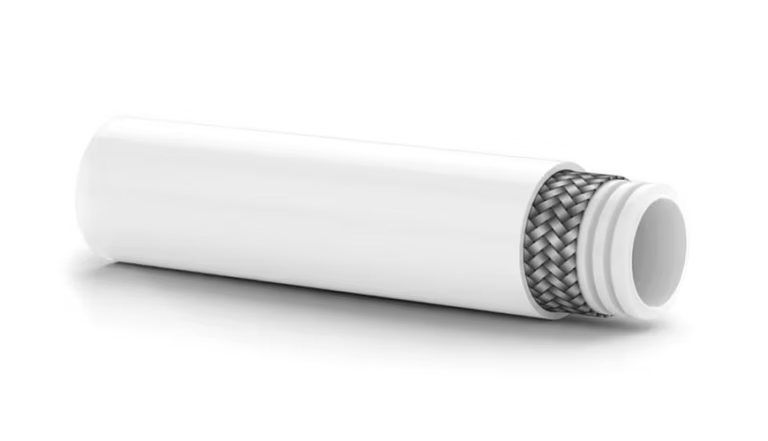
Suitable for most applications in areas with high quality requirements such as the Food, Pharmaceutical, Cosmetic, Chemical and Automotive industries.
6
variaties
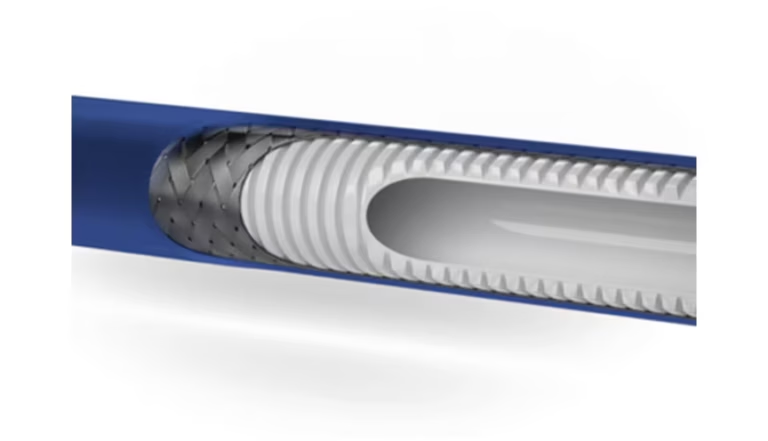
Suitable for most applications in areas with high quality requirements such as the Food, Pharmaceutical, Cosmetic, Chemical and Automotive industries.
6
variaties
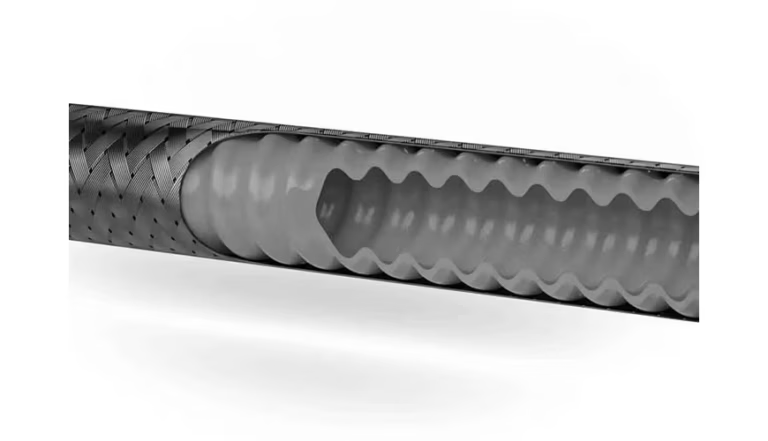
Suitable for most applications in areas with high quality requirements such as the Food, Pharmaceutical, Cosmetic, Chemical and Automotive industries.
9
variaties
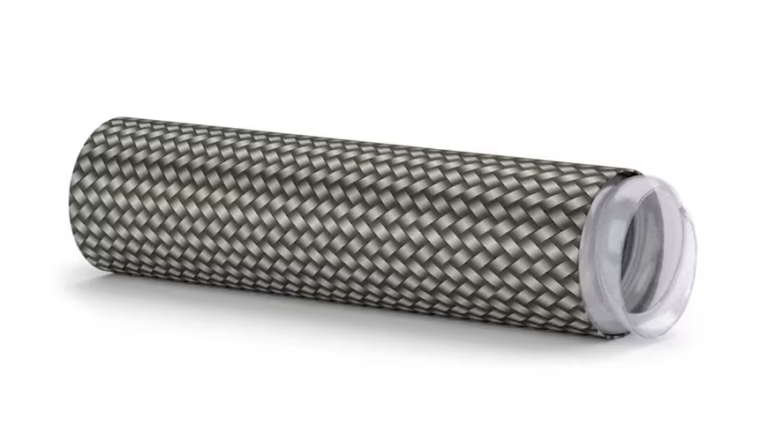
Highly flexible PTFE hose suitable for food products, various types of chemicals, and solvents. The hose is not intended for use with gases at high temperatures.
10
variaties