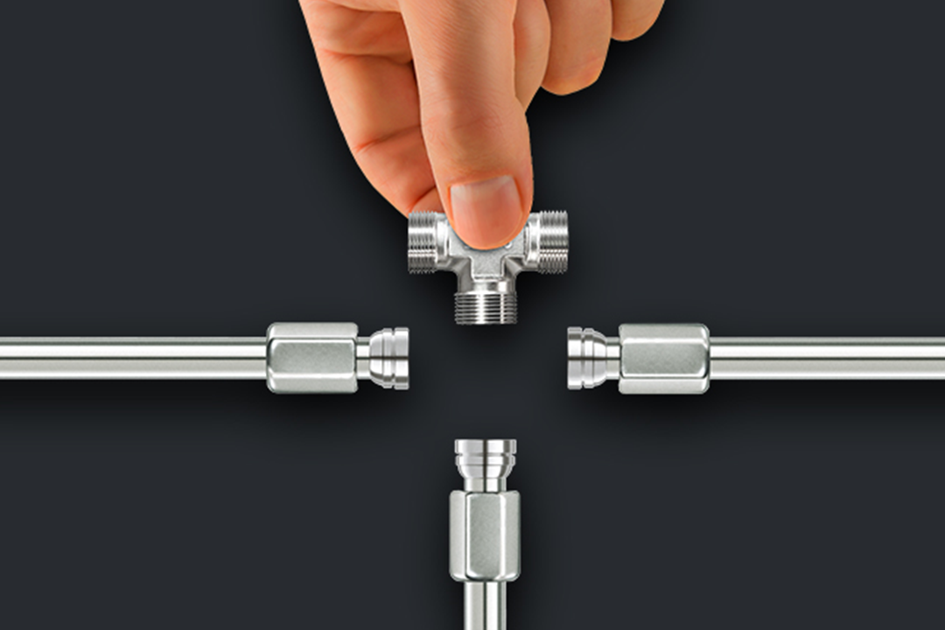
Correct hose assembly is essential to ensure functionality, durability and leakage safety in any type of liquid or gas installation. This guide provides you with concrete advice on how to select the right hose coupling, measure correctly and install the hose in a way that minimizes the risk of it twisting, bending or coming loose from the connections.
Installing the hose safely and securely
Assembling the hose correctly with sufficient slack, optimal bends and without twisting is essential for a safe and efficient installation. An incorrectly installed hose can cause damage to both the hose and the hose couplings. Stresses that can lead to leaks or the hose completely releasing from its coupling, which can have devastating consequences. A correctly fitted hose with a planned installation will give a good lifetime to your hose and also easier maintenance.
What is the right length of my hose?
A basic rule is that the hose must be longer than the distance between your two connections. When a hose is pressurized, its diameter increases and its length decreases due to the pressure force. Proper slack reduces the risk of overstretching if the hose is too short and chafing if the hose is too long.
Why is the bending radius important for hoses?
Hoses and tubing with mechanical properties such as steel wire reinforcement limiting its flexibility. The larger the bending radius, the less the flexibility of the hose. Therefore, you need to keep track of the minimum bending radius of the hose and make sure not to bend the hose more than allowed, so that the wire reinforcement does not get a permanent curvature and the hose does not get a sharp bend.
What does it mean when a hose crashes?
To ensure a smooth flow into the hose, leave the hose straight for a distance equal to at least twice its inside diameter. This will guide the fluid straight into the hose, prevent it from crashing into the inner tube, and protect both the hose's function and lifetime.
Why should you avoid twisting the hose?
A hose that is twisted loses life and durability. You can reduce the mechanical load by straight installations preferably on a plane for hose assembly with less or no twisting.
What is a compound bend?
A hose installation that moves in several directions is called a compound bend. If the hose only bends in one direction - up, down, right or left - it is a simple plane of movement. But when the hose moves in a combination of directions, you create a compound bend. Such an assembly increases the risk of twisting the hose, because the hose ends are stuck and cannot follow the movement.
Tips for better hose motoring
- RED - Incorrect installation
- BLACK - Correct installation
Give the hose slack
Avoid sharp bends and twists by installing angle couplings. Always choose the right coupling type to minimize the number of bends. This will reduce wear and tear and result in a neater and more orderly installation.

Reduce inflections
To reduce the number of bends on the hose, you can use an angle adapter of 90 or 45 degrees. From three to one bend in this installation. Sharp bends wear out the hose faster and shorten the life of the hose.

Use angle coupling
Sharp bends and twists are avoided by using angle couplings. Always use the correct coupling type to reduce the number of bends as much as possible. This avoids unnecessary wear and tear and results in a neater and cleaner installation.

Avoid twisting
The hose has longitudinal markings to allow you to check during installation that the hose is not twisted. A twist on the hose of only 7 % costs 90 % of hose life. Use two wrenches and the marking line to prevent twisting.

Do you need help with hoses and fittings for your installation?
The right hose, length, and coupling are essential for a safe installation with a long service life. Our specialists will help you choose a solution that suits your application and how the hose will be installed.