Hose Measurement – From Cutting to Installation
The correct hose length is important to prevent kinking, creasing, unnecessary tension, and damage to the hose or couplings. How the length is measured depends on the type of coupling at each end of the hose.
Also take into account the hose’s bend radius, movement within the installation, and changes in pressure and temperature. A properly fitted hose is more likely to function safely and last longer.
In the guide below, we show you how to measure the hose length for several common connection types.
How to measure your hose

Internally threaded couplings
Measure the distance between the sealing surfaces of the couplings.

Internal-threaded coupling and 90° elbow coupling
Measure the distance between the centerline of the angle coupling and the sealing surface of the straight coupling.

90° and 45° angle couplings
Measure the distance between the centerlines of the couplings.

Externally and internally threaded couplings
Measure the distance between the sealing surfaces of the couplings.

Two 90° elbow fittings
Measure the distance between the centerlines of the couplings.
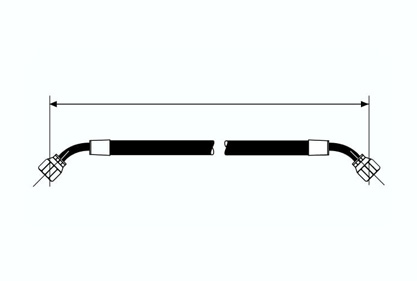
Two 45° angle couplings
Measure the distance between the centerlines of the couplings.

Externally threaded couplings
Measure the distance between the sealing surfaces of the couplings.

Banjo couplings
Measure the distance between the centerlines of the holes.
What does "hose length" mean?
The length of the hose normally refers to the length of the finished hose assembly, including couplings. The measurement points vary depending on the type of coupling. For straight couplings, the length is often measured between the sealing surfaces, while angled couplings are usually measured from the centerline.
It is therefore important to specify both the desired length and the types of fittings to be installed at the ends of the hose.
How do you calculate the correct hose length?
The hose must be long enough to allow for movement and bending without being stretched, twisted, or subjected to stress at the couplings. The bend should not start immediately at the fitting; instead, a short straight section should be left at both ends.
Also take into account the hose’s minimum bend radius and any movement in the installation. A hose that is too short is subjected to unnecessary stress, while a hose that is too long can cause kinks, wear, or unwanted movement.
Example of hose length calculation for fixed and mobile installation

FV. FAST INSTALLATION
Length = 2A + 3.14 x 2R. Length = 2A + X

FH. MOBILE INSTALLATION
Length = 2A + X + T.
- A: straight hose length at the connection
- A: the hose's bend radius
- X: the distance between the connections
- T: travel distance of the installation
Common Mistakes When Measuring the Length of a Hose
- Measuring from the outermost ends of the couplings instead of from the sealing surface or centerline. Not taking the hose’s minimum bend radius into account.
- Have the bend start right at the sleeve.
- Choosing a hose that is too short and stretches when under pressure or in motion.
- Installing the hose while it is twisted.
- Failing to take temperature changes or moving parts into account.
Do you need help measuring or choosing the right hose?
The length of the hose must be adapted to the connection type, fittings, bend radius, and how the hose will be installed in the application. We’re happy to help you verify the dimensions and select a hose solution with the correct length and connections.
Contact us and we'll help you find the right hose for your application.
Get help choosing the right hose