How to know which hose is approved for what in demanding environments

In the process industry, it's not just a matter of screwing on a hose and pressing start. Not when you're handling pharmaceuticals, food or chemicals where every gram, every particle - and every contact - counts.
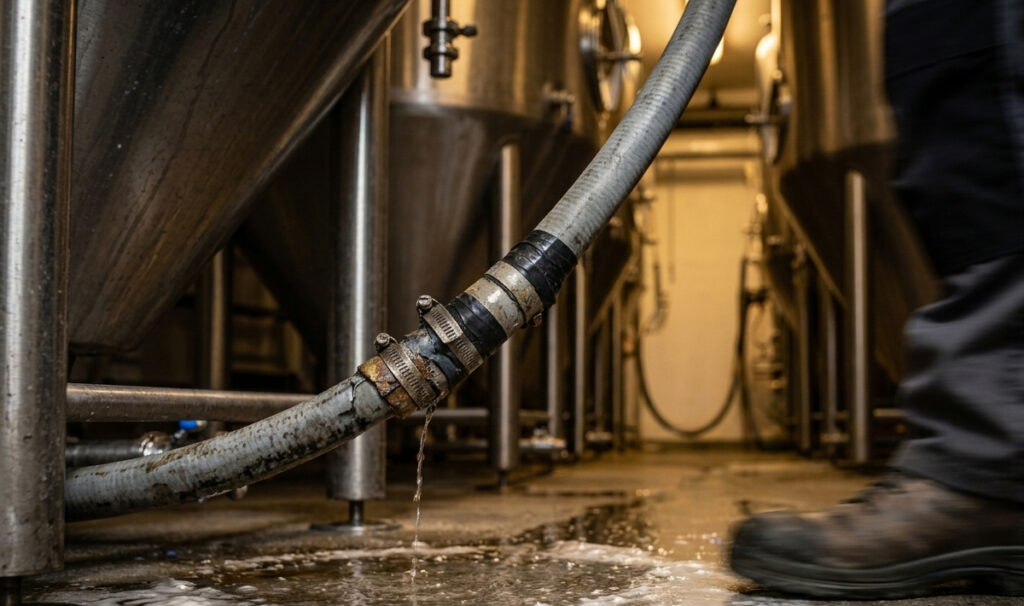
There are high standards here. And rightly so. A faulty hose can contaminate the product, affect worker safety, ruin a batch or cause a shutdown, a costly recall - or an ATEX incident.
And even if the hose looks right on the outside, it's the inside (and the documentation!) that determines whether it's actually approved for the job.
So - what does it really mean? Here's a quick guide to some of the most common approvals:
FDA
Approval from the US Food & Drug Administration. Common in both food and pharmaceuticals - especially when exporting to the US. Ensures that the material does not release harmful substances into the product. But keep in mind that it is primarily a material approval, not a product approval.
USP Class VI
It is mainly used by companies in the pharmaceutical and biotechnology industries. They test the biocompatibility of the material - that is, that it does not cause negative reactions in the body. They often require this for tubing to be used in contact with injection fluids or biological media. The requirements are tougher than the FDA, but it is not a substitute for it.
EU 10/2011
An EU regulation specifies which plastic materials can come into contact with food. Users often carry out migration tests to measure how much material is released into the food - but such tests do not prove that the material meets the requirements for food classification.
BfR
German standard often requested by European customers - especially in food. Sometimes it overlaps with EU 10/2011, but BfR is often more detailed and can provide guidance where EU regulations are unclear.
ATEX
Okay, this is not about hygiene - but it is still critical in many facilities. ATEX applies to equipment used in explosive environments (e.g. dust, solvents or powders). Here, hoses must be able to be earthed, be conductive and not build up static electricity.
3-A Sanitary Standard
A hygiene standard from the USA, often used in dairy and beverage. It's not just the material that counts - construction, cleanability and surface smoothness are also considered.
Other labels (Phthalate-free, BPA-free, Animal-free etc.)
These are not regulatory requirements, but often policy requirements from customers. They can be about environmental profile, export requirements, halal/kosher compliance or avoiding animal residues in the manufacturing process.
A hose is more than just a hose. It is a technical component with legal, hygienic and often commercial requirements. At Colly Flowtech AB, we help you navigate the regulations, understand what you really need - and deliver the right hose with the right documentation.
This text was written by Tobias Sander (tobias.sander@colly.se), Sales Manager Hoses at Colly Flowtech.
Osäker på vilka krav din slang behöver uppfylla?
Olika processer ställer olika krav på material, märkning och dokumentation. Våra slangspecialister hjälper dig att reda ut vilka krav som gäller för din applikation och hitta en slang som passar.
Do you have any questions?